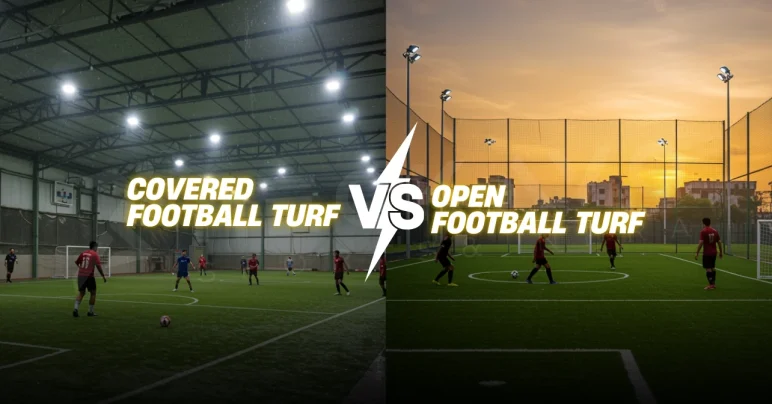
Football turfs have become a popular sports business across India. However, one important decision turf investors face is whether to build a covered football turf or an open turf ground.
This guide explains the differences, costs, benefits, and booking potential of covered and open football turfs to help you make the right decision.
What Is a Covered Football Turf?
A covered football turf is a ground that has a roof structure or canopy installed above the playing area.
This roof protects players from rain, harsh sunlight, and extreme weather.
Key features of covered turfs
- Steel or tensile roof structure
- Weather protection for players
- Better lighting control
- Comfortable playing environment
Covered turfs are becoming popular in cities with heavy rainfall or extreme heat.
What Is an Open Football Turf?
An open football turf is a standard artificial football ground without any roof structure.
The turf is exposed to natural sunlight and open weather conditions.
Key features of open turfs
- Lower construction cost
- Natural air circulation
- Simple design structure
- Easier installation process
Many football turfs in India are built as open grounds because they require lower investment.
Covered Turf vs Open Turf (Comparison Table)
| Factor | Covered Football Turf | Open Football Turf |
| Construction Cost | Higher | Lower |
| Weather Protection | Excellent | Limited |
| Player Comfort | Very good | Depends on weather |
| Maintenance | Slightly higher | Moderate |
| Booking Consistency | High | Weather dependent |
| Construction Time | Longer | Faster |
Covered turfs offer better booking stability, while open turfs require lower investment.
Advantages of Covered Football Turf
Covered turfs provide several operational benefits.
1. Protection from Rain
Rain often cancels matches in open turfs.
Covered structures allow games to continue even during monsoon seasons.
2. Higher Booking Consistency
Since weather interruptions are reduced, covered turfs often experience more consistent bookings throughout the year.
This improves overall business revenue stability.
3. Better Player Experience
Players prefer comfortable playing environments.
A roof structure reduces:
- Direct sunlight
- Heat exposure
- Rain interruptions
This creates a more professional playing experience.
Advantages of Open Football Turf
Open football turfs also have strong advantages.
1. Lower Initial Investment
Open turfs require no roofing structure, making them significantly cheaper to build.
This reduces the initial capital requirement.
2. Faster Construction Time
Without roof installation, open turfs can usually be completed faster than covered turfs.
This allows turf owners to start generating revenue sooner.
3. Natural Playing Environment
Many players enjoy playing under natural light and open air.
Open turfs provide a more traditional outdoor football experience.
Cost Comparison: Covered vs Open Turf
Roof structures significantly affect the overall project cost.
Estimated Cost Difference for 8000Sqft Football Turf (Approx.)
| Turf Type | Average Construction Cost |
| Open Football Turf | ₹20 – ₹25 lakh |
| Covered Football Turf | ₹40 – ₹50 lakh |
The roof structure can add 15-30 lakh rupees depending on materials and size.
Booking Potential Comparison
Weather plays a major role in turf bookings.
Average Booking Stability
| Turf Type | Booking Stability |
| Covered Turf | 85–95% |
| Open Turf | 65–85% |
Covered turfs maintain more consistent bookings during rainy seasons.
Which Turf Is Better for Business?
The best option depends on your location and budget.
Covered turf is better if
- Your city has heavy rainfall
- You want consistent bookings
- You have higher investment capacity
Open turf is better if
- You want lower construction cost
- Weather conditions are stable
- You want faster project completion
Both options can become profitable when managed properly.
Conclusion
Choosing between a covered football turf and an open turf depends on budget, climate, and business goals.
Covered turfs offer weather protection and consistent bookings, while open turfs provide lower investment and faster construction.
By evaluating these factors carefully, turf investors can build a facility that delivers long-term profitability and a great playing experience.
Do check out these links for more information: